The basis of this analysis was completed by Dr. C. Truman Davis, originally published in Arizona Medicine, 1965, Arizona Medical Association. Dr. Davis is a graduate of the University of Tennessee College of Medicine. He is a nationally recognized Opthamologist, and vice president of the American Association of Opthamology.
Also contributing to this compilation analysis are the findings of Alexander Metherelli, M.D., PH.D. Dr. Metherelli has a medical degree from the University of Miami in Florida and a doctorate in engineering from the University of Bristol in England. He is board certified in diagnosis by the American Board of Radiology and has been a consultant to the National Heart, Lung, and Blood Institute of the National Institutes of Health of Bethesda, Maryland. Dr. Metherelli's added insight has been gathered and added from The Case For Christ by Lee Strobel.
NOTE: Pleased be advised that this discription is not for the faint of heart. It contains medical terminology and objective descriptions of the trauma the physical human body endured during the Roman practice of crucifixion.
The Garden of Gethsemane
"And being in agony, He prayed longer. And His sweat became as drops of blood." Luke 22:44.
The occurrance of hematidrosis has been well documented in the medical field, and this condition is associated with severe psychological stress. In this condition, severe anxiety causes the release of chemicals that break down the capillaries in the sweat glands. Because of this rupture, a small amount of bleeding occurs, and the individual sweats, and the sweat is twinged with blood. Hematidrosis causes the skin to become extremely fragile and sensative.
Before Pontias Pilate - The Scourging
While Jesus suffered no abuse from Pilate, himself, he condemned Jesus to scourging and crucifixion. A prisoner under this condemnation was stripped of his clothes and his hands were tied to a post above his head. A Roman legionnaire would step forward with a flagrum or flagellum. Normally, flogging would consist of 39 lashes, however, the number often depended on the mood of the scourging soldier. This instrument used was a short whip consisting of several heavy thongs of leather with two small balls braided into each thong at the end. Also embraided in the thongs were hard pieces of sharp bone. The whip was brought down with heavy blows across the prisoner's legs, buttocks, back, and shoulders. When the whip struck, the balls caused deep bruises or contusions which broke open with further striking. The sharp pieces of bone would shred the skin to the point that even part of the spinal column of the prisoner would be exposed. This instrument tore into skeletal muscle and often laid the prisoner's veins and bowels bare. Because Jesus was already suffering from hematidrosis, His skin was particularly susceptible to the bruising and shredding power of the flagellum. Most people condemned to crucifixion never actually made it to their crosses - they died from this beating, first.
Surviving victims were in a tremendous amount of pain, experienced large amounts of blood loss, and their bodies usually went into hypovolemic shock. While in hypovolemic shock, the heart races to pump blood that isn't there. The blood pressure drops, causing fainting and collapse of the victim. The kidneys ceace to produce urine in an attempt to maintain what bodily fluid volume is left. The victim often becomes thirsty, which is the body's response to try to replace the lost blood volume.
The Soldiers' Mockery
When the beating was over, the soldiers allowed Jesus to slump to the ground. They saw humor in the fact that this man, who claimed to be the King of the Jews, was reduced to just a gasping, bloody mass. They threw a robe around His shoulders, the weight of which caused the cloth's fibers to stick to the ribbons and nerves of the exposed ribbons of flesh and exposed muscle tissue. The soldiers then needed a crown to make their travesty complete. Small, flexible branches, riddled with thorns that were used for the cording of kindling wood were braided into a crown. The crown of thorns were forcibly smashed upon the head of Jesus, causing copius bleeding as the thorns pierced the vascular tissue of Jesus' head. The soldiers then proceeded to circle Him, spitting on Him, smacking Him in the face, and hitting the crown upon His head, which drove the thorns in further. Finally, when they had their fill of the mockery, they ripped the robe from Jesus' back, which had become adherant to the blood and serum in the wounds, and the clots were painfully torn away, causing the wounds to bleed again, just as in the careless removal of a surgical bandage.
Golgotha - The Place of the Skull
In keeping with Jewish custom, the soldiers returned Jesus' clothes to Him. A heavy crossbar (called a patibulum) was tied to Jesus' shoulders. As was the custom, condemned prisoners were marched through the streets of the city as they carried their crossbars to the permanent upright stakes at the crucifixion mound. The Romans would parade these victims in an attempt to publically display the punishment for crime, as a deterrant act for the general public. The public, however, also took sport in the spectacle, spitting on and throwing objects at the condemned. It was a 650 yard walk from the Fortress Antonia to Golgotha - the crucifixion place. However a short walk, the victims' bodies had already been pushed beyond the limits of human endurance. While Jesus walked, He fell, causing the heavy crossbar to drive its splinters in His open-wounded back and shoulders.
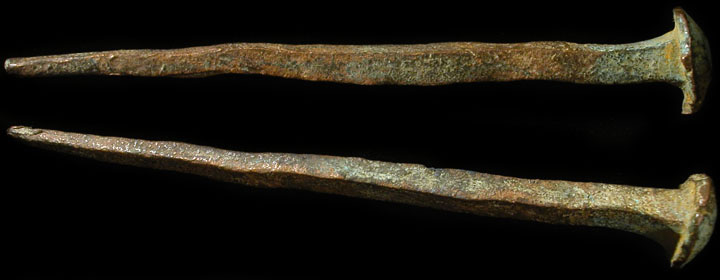
Once the prisoners reached the crucifixion mound, they were offered a wine mixed with myrrh, which acted like an analgesic, pain relieving mixture. Jesus, however, refused this drink and endured the full force of the torture that would occur next. The prisoner would be laid down and his arms outstretched across the beam. The legionnaire would feel for the depression in the wrist in which the nails would be driven. The Romans used nails that were actually 5"-7" long spikes. They were driven through the wrist where the median nerve runs, and this nerve would be crushed. It felt the same as if you hit your "funny bone", althought the pain was more of that of a pair of pliers crimping and twisting this nerve without end. Pain of this very occurrance was so great that the language of the time had no word powerful enough to describe it, and a new word was invented just for this purpose. That word is "excruciating" and means "out of the cross".
Once the spikes were driven, it was time to hoist the crossbar onto the vertical post. When the crossbar was hammered into place, the victims shoulders would dislocate from the dead-weight pull of gravity on the exhausted body. The victim's feet were then nailed into place, using the same sized spikes as the wrists, and he would feel the same pain as in his hands, due to the crushing of the nerves. With the left foot tucked behind the right, and the knees slightly bent, the spike would be driven through the arches of both feet. The victim was now crucified. As was the Roman custom, a plaquard, upon which was written the crime of the crucified man, was nailed above his head. Jesus' plaqueard read, "Jesus of Nazareth, King of the Jews".
Death By Crucifixion - The Process
Crucifixion meant a slow, painful death by asphyxiation. Stresses on the muscles and diaphragm caused the chest and lungs to remain in an inhaled position. To exhale, the victim was forced to press upon the nail of the feet and raise himself up. The pressure of the nail would tear into the foot, locking up the tarsal bones. As the victim pushed up, the rough-hewn splintered wood of the vertical beam would further shred the back and remove any clots that had again formed since the prior flogging. Pieces of wood would lodge in the wounds. This action would continue until the person couldn't push up any longer. At this point, as the arms fatigued, great waves of throbbing pain and cramps set into the muscle tissue. Hanging by the arms, the pectoral muscles (the large muscles of the chest) were paralyzed, and the intercostal muscles (the small muscles between the ribs) were unable to act. Air could be drawn into the lungs, but it could not be exhaled. At this point, the person goes into respiratory acidosis, during which carbon dioxide in the blood is dissolved as carbonic acid. The acidity of the blood increases causing an irregular heartbeat, ultimately leading to cardiac arrest. Because they hypovolemic shock would have already sustained a rapid heart rate, the new irregularity would result in total heart failure. Once the body had reached this point, fluid would have collected in the membranes surrounding the heart and lungs (called the pericardial and pleural sacs, respectively). This is called "pericardial (heart) effusion" and "pleural (lung) effusion."
The common method of final death was called "crucifracture", in which the legs of the crucified were broken by an iron bar in order to speed up the dying process. Once the legs were broken, the victims could no longer push up to exhale. During Jesus' crucifixion, the legionnaires had a special interest in hurrying-up the condemned, as the Jews demanded that there be no crucifixions on the Sabbath or during Passover, which were both scheduled to begin at sunset that day. As the soldiers made their rounds of crucifracture, they arrived a Jesus' body and found that He was already dead. To be sure, a soldier thrust his spear in to Jesus' side, apparently piercing the cavities surrounding His heart and lungs. John 19:34 records that John, the disciple whom Jesus loved, saw blood and water flow from His side - the pericardial and pleural effusions.
This is post-mortem conclusive evidence that Jesus did not die of the expected suffocation as did most crucified prisoners, but rather that He died of heart failure due to shock and constriction of the heart by fluid in the pericardium.

No comments:
Post a Comment